
Cleveland, Ohio

Remember Balto? If not, he was one of the sled dogs that helped with the 1925 Serum Run to Nome, Alaska. They made a movie about him in 1995, and his body is on display at the Cleveland Museum of Natural History. How did he end up in Ohio? It involved a lot of very fast fundraising.
Balto’s Historic Sled Run

The year is 1925. The local clinic in Nome, Alaska, realized that its anti-diphtheria medication had expired, just as an outbreak of the disease started. Diphtheria is highly contagious and spreads through both physical contact and through the air. During its final stages, a membrane of sorts grows in the throat, causing it to block the airway. While there are now vaccines to prevent the disease, it wasn’t common in 1925, so the clinic workers had to rely on the antitoxin to control the outbreak.
It being Alaska, getting the new antitoxin from Anchorage to Nome turned out to be quite an ordeal. The serum had to travel by plane (remember that air travel was also new during this time period) to the town of Nenana, where sled dogs took over. Balto was the lead dog during the final push to Nome, giving him all of the media attention.
After the Serum Run

Balto became a national hero and media sensation, even though 18 other sled dog teams and 150 other sled dogs participated in the Serum Run. A movie featuring Balto was planned, a statue of him went up in Central Park, and then he and his teammates were sold to a man who owned a traveling circus named Sam Houston.
For several years, Houston led the dogs around the country, but he wound up mistreating them. News reports mentioned that the dogs were kept in a back room and were so underfed that their ribs were showing. A campaign began to get Balto and his teammates out of Sam Houston’s hands, and a Clevelander named George Kimbal took the lead.
Raising Money to Buy Balto

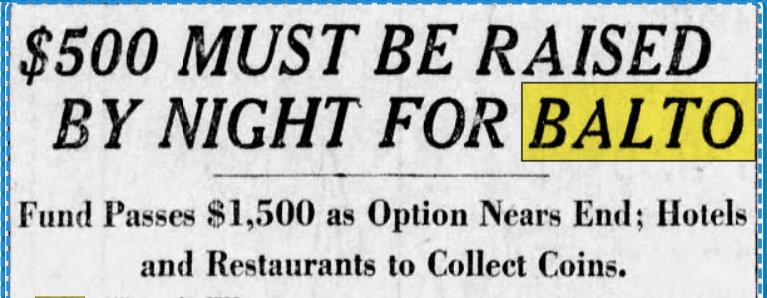
Of course, Balto’s owner wasn’t going to just donate him to the Brookpark Zoo (now the Cleveland Metroparks Zoo), so Kimble started an organization called the Cleveland Balto Committee. People sent in money from all over the city, with kids even donating the loose change that they’d use to buy milk. There was a strict deadline of ten days to raise the $2,000 that Houston wanted for Balto and his time, and Clevelanders met it.
March 19, 1927 – Balto Day

Balto and crew arrived in Cleveland on March 16th and went straight to their new temporary quarters at the zoo. A local judge created a deed of gift presenting ownership of Balto, Alaska Slim, Fox, Tillie, Billie, Old Moctoc, and Sye to the city of Cleveland. Three days later, a parade was held in their honor and the day, March 19th, 1927 was declared Balto Day.
After that, the dogs moved into a more permanent home at the zoo, where they spent the rest of their days. In their younger years there (the whole pack was born in 1919), they would pull a sled around the zoo on winter days, but as time progressed and they aged, the dogs mainly stayed in their shelter where visitors could see them. By 1933, the only two left were Balto and Sye.

Balto passed away of old age on March 14, 1933. His remains were professionally taxidermied and placed on display at the Cleveland Museum of Natural History, where they remain. You can see him in their Visitor Hall.
As for Sye? He died in March of 1934. He was also taxidermied and displayed at the zoo, but at some point he was moved into storage and lost. The other dogs in the pack, Alaska Slim, Fox, Tillie, Billie, and Old Moctoc, all died between 1929 and 1932. No one is quite sure where their remains are either.
Leave a Reply