Independence/Parma, Ohio
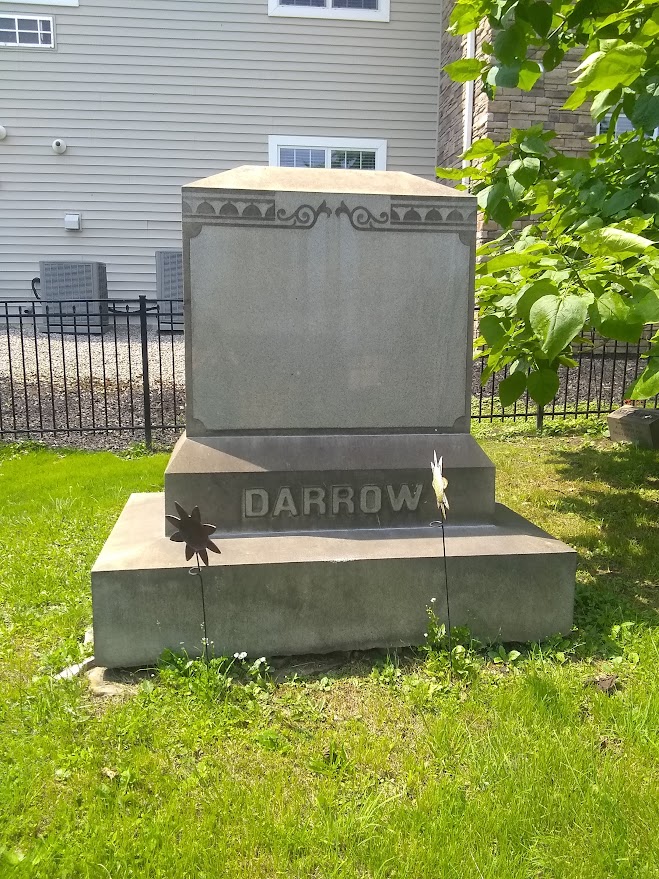
The Darrow family played a prominent role in early Independence Township, but you’d never know it based on where their cemetery is located. In order to find it, you need to turn onto Old Rockside Road from (new) Rockside Road, then travel halfway down the plot of land that is now an assisted living and rehabilitation facility.
Once you get there, beneath a few trees and up a small hill, you’ll see the iron fencing and few remaining graves of this interesting family. You could drive past it hundreds of times and never know that it’s there.
The Darrow Family
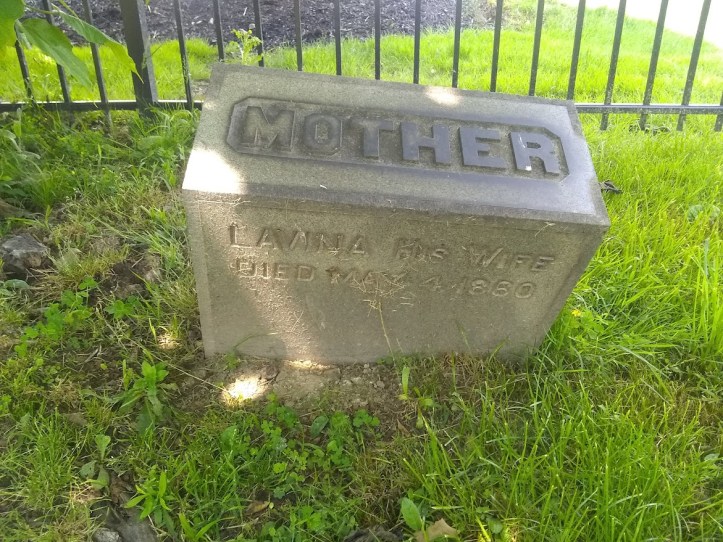
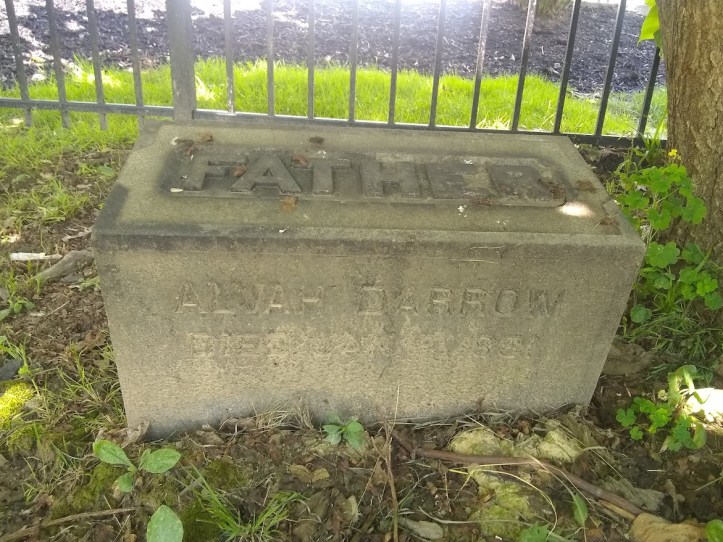
According to a survey done in the 1940s by WPA workers, the cemetery once had enough space for four rows of ten graves each. However, most of the space wasn’t filled or didn’t have visible headstones. The few that are noted in the WPA survey are the same ones that are still located there, with the exception of the gravestone labeled “daughters of A + L Darrow.”
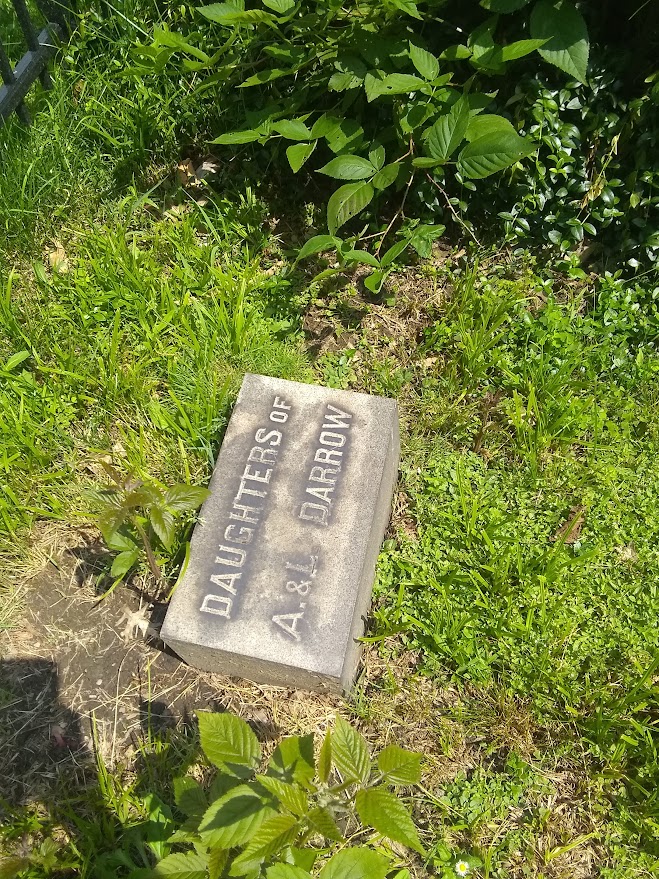
The known burials there include Alvah Darrow (1804 to 1881), his wife Lavina (1809 to 1860),and their daughter Elizabeth (1841 to 1895.) It’s possible that Alvah’s father, Alexander Darrow (1774 to sometime in the 1820s) is buried in the cemetery as well, but he doesn’t have a specific headstone.
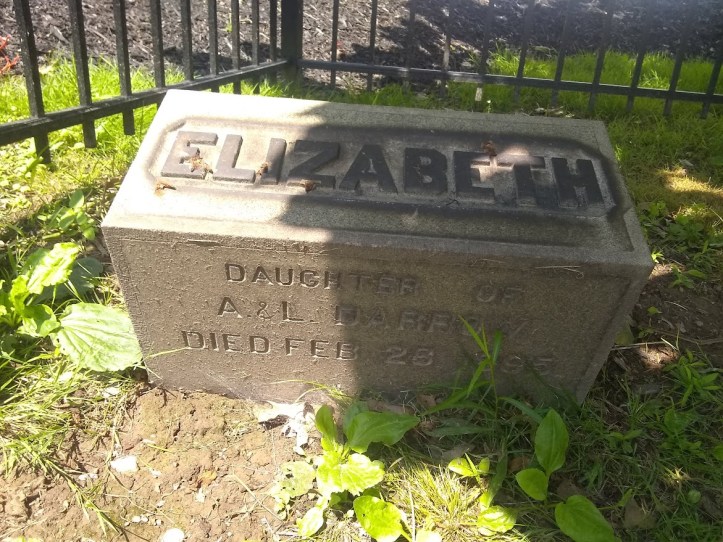
Although the main patriarch of the family, Alexander, who served in the War of 1812 and moved to what is now Independence from New York state, begins the tale, it’s his sons, Alvah and Nathan, where things get interesting.
Darrow Family Land
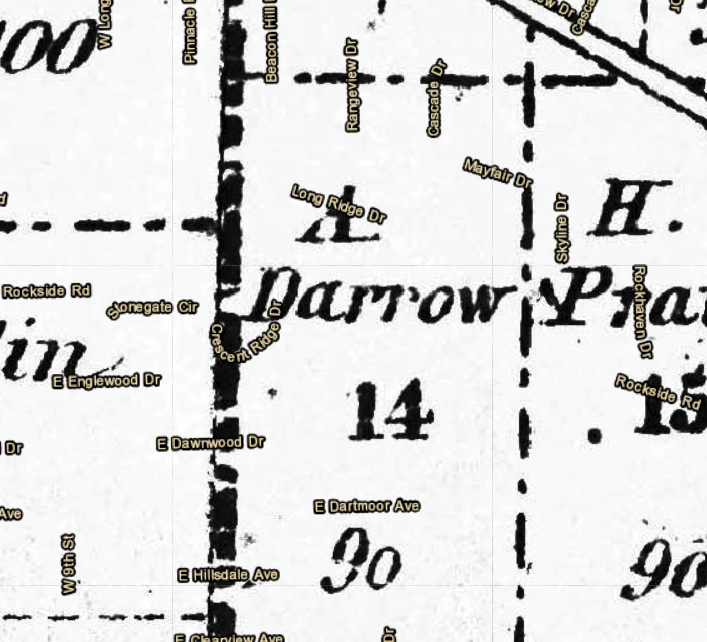
The family first shows up on the 1852 map. The current streets are labeled, making it easy to see where modern-day Rockside cuts through the land.
By this point in time, the land is owned by Alvah, and his wife and their four children reside on it. The kids, including Kneeland, Elizabeth, Melchor, and Orion appear either in the cemetery or in the census and property records over the years.
Alvah, according to Independence township records, served as a Fence Viewer for the city prior to 1834. This position consists of listening to property disputes over fence lines and related matters, and making decisions based on the facts provided. He also served as an election clerk for the township.
Looking at later records (those from 1834 and earlier no longer exist), Alvah served as a township trustee in 1835, 1843, 1844, 1845, 1849, and 1853.

The family appears on the 1874 map (above) and the 1927 one (below):
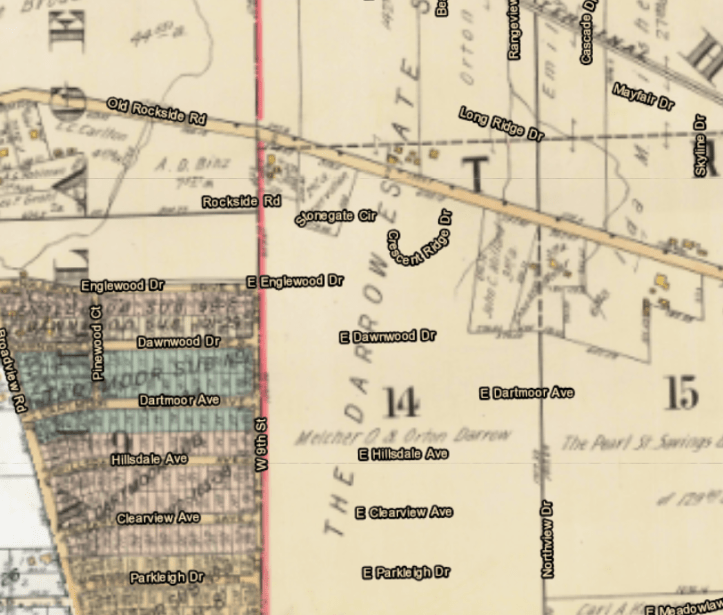
After Alvah died in 1881, the land went to his sons, Melchor and Orion. Why didn’t Kneeland inherit anything?
According to a newspaper article, Kneeland and his father got into an argument in 1861. Kneeland took off and joined the Union Army, fighting in the Civil War. He didn’t return to Independence until well after his father has died, and since no one in the family had heard from him in years, they assumed he was in Killed in Action. This wasn’t the case at all:
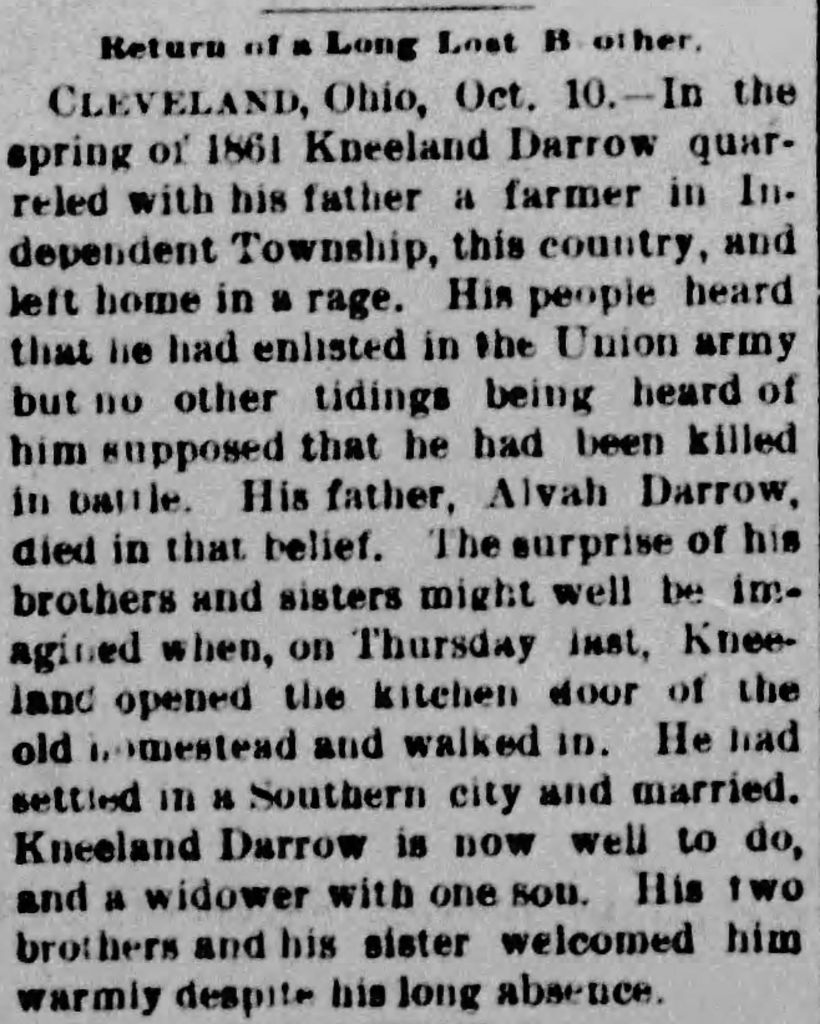
Kneeland Darrow is buried in Brooklyn Heights Cemetery. At the time of his death in 1913, his next of kin is listed as his nephew, Carl (Melchor’s son.)
Alvah’s remaining children seemed to live uneventful lives on the family farm. Elizabeth never married, Melchor married Laura Dexheimer Darrow in 1876 and had two kids (Alvah and Carl), and Orion, who also apparently never married, is buried in Brooklyn Heights Cemetery near Kneeland.
What About the Other Darrows?
Alvah had an older brother, Nathan (born 1799 in New York State and died 1868 in Eaton Rapids, MI). He was married twice; once to Polly Mather Darrow (daughter of Watrous Mather of yes, those New England Mathers that are related to Cotton) in 1824, and after her death, to Prudence W. Lewis Darrow, in 1838.
Nathan and Polly had one daughter, Minerva, who, in 1845, married her cousin, Daniel M. Brown. Daniel was the son of the notorious Boston Township (and Hudson) counterfeiter James Brown (not to be confused with abolitionist John Brown). Cousins? James Brown married Lucy Watrous Mather Brown, who was one of Polly’s older siblings.
James Brown’s counterfeiting exploits in the area are well known, and his son followed directly in his footsteps. Among other crimes, Daniel made and passed around counterfeit coins. He was sentenced to ten years in prison and died there, before being posthumously pardoned by President Millard Fillmore in 1851.
Minerva went on to marry Alexander Brewster in 1857 and both are buried in Akron’s Glendale Cemetery.
Sources
- https://www.findagrave.com/memorial/185082481/kneeland-alvah-darrow
- https://www.findagrave.com/memorial/142659755/watrous-mather
- https://www.findagrave.com/memorial/185082481/kneeland-alvah-darrow
- https://www.hauntedplaces.org/item/darrow-family-cemetery/
- http://www.usgwarchives.net/oh/tombpics/cuyahoga/independencetwp/darrowcem/darrowcem.htm
- https://cpl.org/newsindex/results/?searchFor=Darrow&searchType=both&search=search
- https://sites.rootsweb.com/~ohcuyah3/independence.html
- https://www.collingwoodtoday.ca/the-blue-mountains-and-grey-highlands/tbm-toes-line-on-1800s-fence-act-7109080
- http://files.usgwarchives.net/oh/cuyahoga/cemetery/darrow1.txt
- https://www.gilderlehrman.org/collection/glc0004315
 Found in Ohio