Cleveland’s Glenville neighborhood, located on the northeast side of the city, is known for several things, including the creation of Superman (Jerry Siegel created the character while still a student at Glenville High School) and the 1968 Glenville shootings. Before all of that, Glenville was a farming community that turned into residential housing.
The Early Days of Glenville
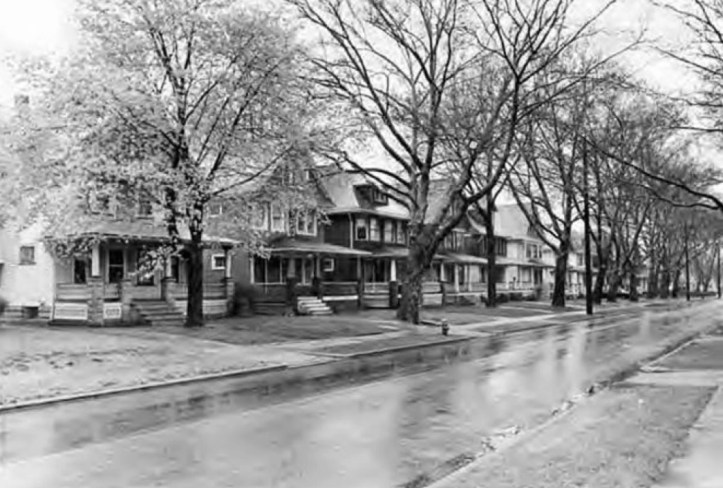
These days, Glenville sits between Lake Erie, Bratenahl, East Cleveland, and several other Cleveland neighborhoods, but back in 1870, it was its own village and full of farmers. The village’s proximity to downtown Cleveland (only a 20-minute streetcar ride to Public Square), combined with its inexpensive open land, led to it becoming the perfect place to live.
By the 1890s, Cleveland was in an industrial boom. People were moving to the city to find jobs, not to set up farms, so any land close to the “action,” so to speak, became a good place to build houses. Several builders of the period, like Lemuel Marvin Southern (also known as L.M. Southern, and check back next week for more on him) took advantage of this and bought large parcels of land that they then turned into small housing developments. Although no signs exist like they do these days, separating one development from another, the early clusters of housing had names like Washington Blvd, Forest Park, and Victoria Park.
Creating Victoria Park
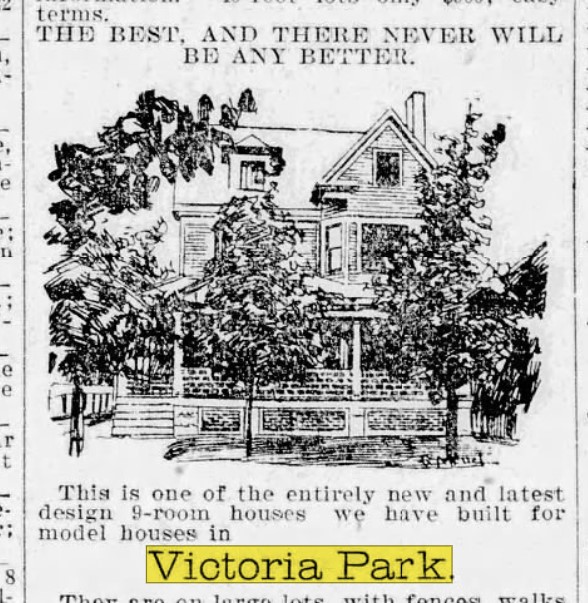
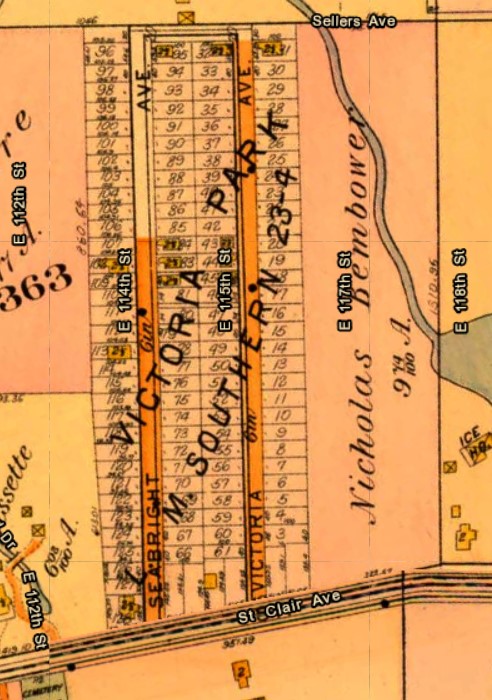
L.M. Southern’s Victoria Park allotment extended from St. Clair to the south to Sellers Avenue to the north, and ranged from E. 114th St to E. 115th St. Ads for the development boasted about its clean, “hygienic,” and non-smoky air, as well as its 40-foot lots and modern amenities for the time, such as street lights and easy access to the St. Clair streetcar line.
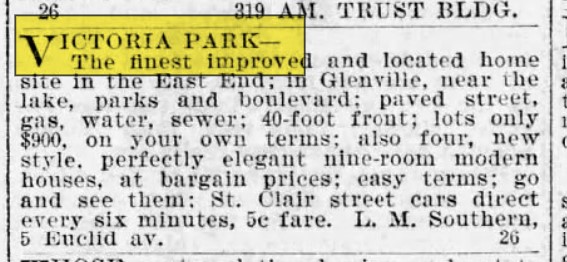
The houses were on paved streets and featured water, sewage, and gas hookups, making them top of the line, yet affordable, for the time period. Developers, L.M. Southern in particular, sold the lots for between $900 and $1,500 a piece, or between $32,000 and $53,000 in today’s money. Even though this still sounds like a lot, note that these developers set up private payment plans with their buyers, allowing them to pay for their new lots over time.

Remember that the government didn’t start backing mortgages until the 1930s, so the only options in the 1890s consisted of private lending situations, many of which were out of reach for the average person. Bypassing all of that and allowing buyers to essentially take out loans with the developers made buying a new house easier for those who worked in factories and in similar industries.
In his real estate ads, L.M. Southern boasted about terms that included $40 down and $20 per month. He didn’t charge any interest on these loans and paid property taxes on the lots out of his own pocket until the property was entirely paid for. The cost for one of the pre-built houses ranged from $3,200 to $5,000 on top of the price of the land.

Looking at the homes in Victoria Park, you’d think that they were kit houses. However, kit homes as we know them today, like those famously sold by Sears, weren’t around until after 1906. Instead, books of home designs by well-known architects at the time, George F. Barber, William Radford, and Max Le Roy Keith, were inexpensive and easy to obtain by mail. Developers could choose the floor plan, order the raw materials (simply and affordably, thanks to nearby railroad tracks), and build the houses for their clients.
The houses in Victoria Park boasted of having nine to ten rooms, including several bedrooms, a parlor, a reception area, a dining area, and a kitchen, along with plenty of basement, attic, and pantry storage. Each had hardwood floors and trim and sat on already sodded, tree-lined lots, so all that the new homeowners had to do was move in.
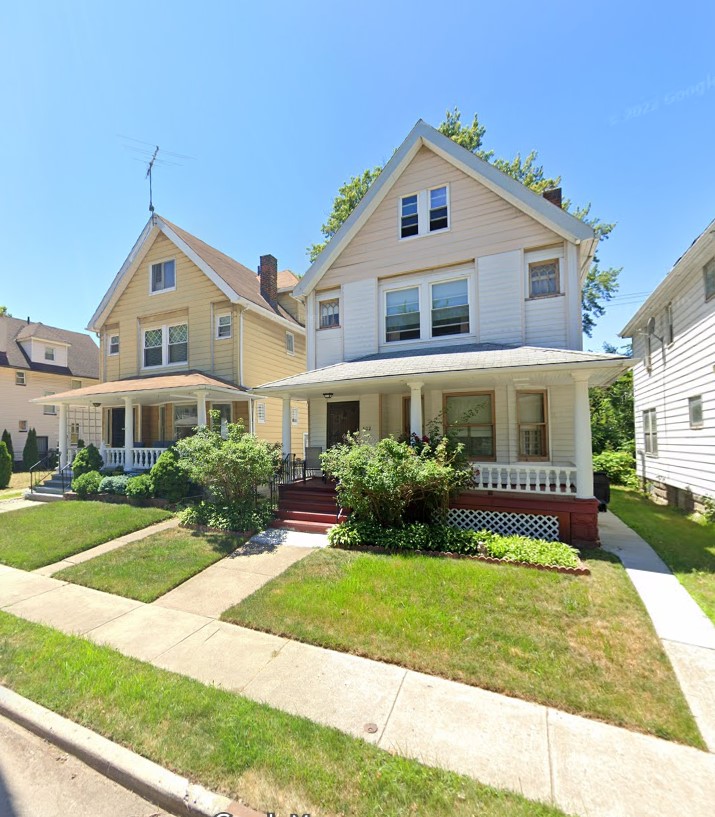
Construction in the area continued through the 1910s, even after Glenville was officially annexed by Cleveland in 1905. L.M. Southern, a developer pretty much lost in time, played a large role in turning the former farmland into a residential area, and many of his houses are still standing today.
Sources
- Encyclopedia of Cleveland History: Glenville
- Cleveland.com: Beyond Superman and the Tarblooders, a tour through Cleveland’s Glenville neighborhood
- PBS: “We Had Everything” – Remembering Glenville Before The 1968 Shootout
- Federal Reserve Bank of Richmond: A Short History of Long-Term Mortgages
- Newspapers.com: The Cleveland Leader and Cleveland Plain Dealer
- Mail-Order Homes: Sears Homes and Other Kit Houses by Rebecca L. Hunter
 Found in Ohio
[…] the fledgling city of Cleveland to extend the streetcar lines to St. Clair Avenue, home of his Victoria Park development. Street lamps soon followed, turning the area into one more desirable for middle-class […]
LikeLike